

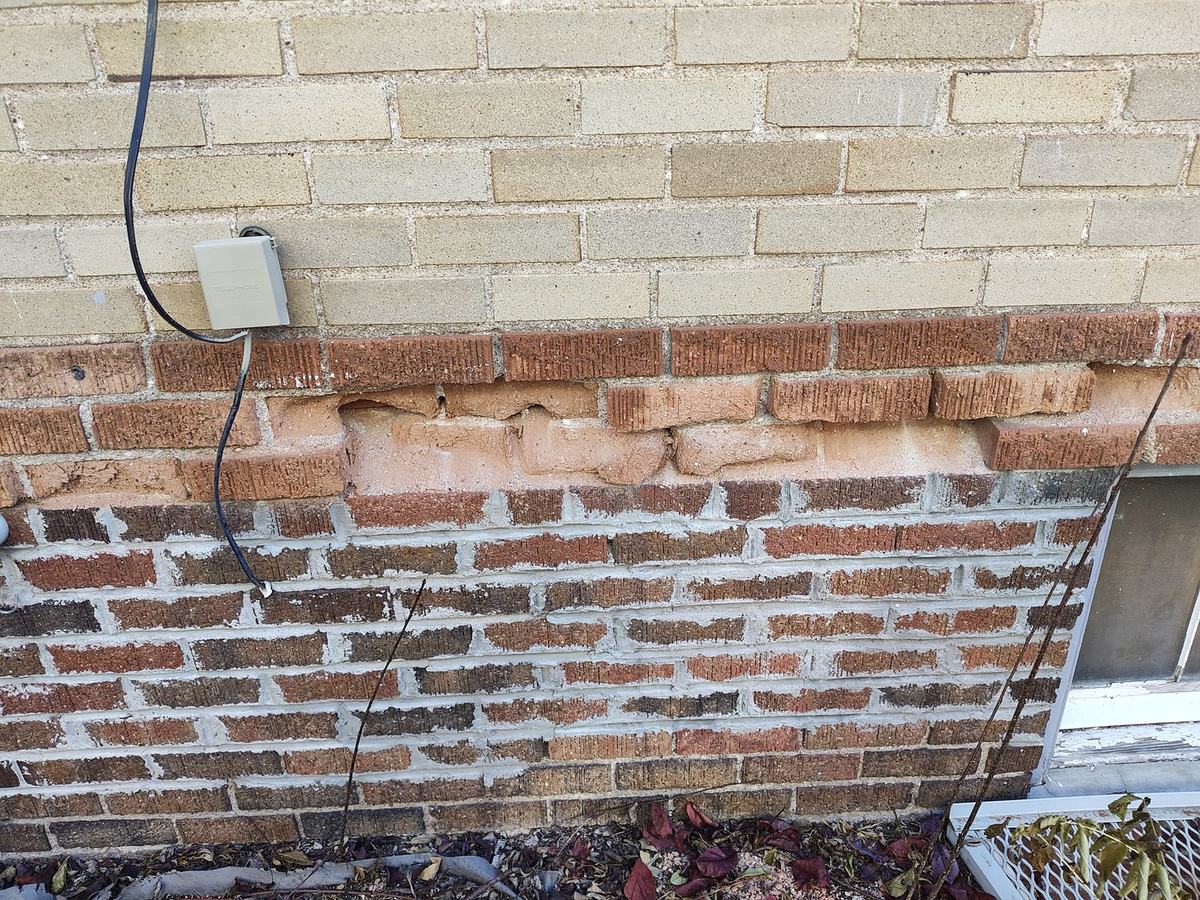
Brick spalling is what happens when the face of a brick breaks away. Sometimes it flakes off in thin layers. Sometimes a whole face pops off and leaves a rough, pitted crater. Look at the ground below a spalling wall and you will often find the pieces.
Spalling does not happen on its own. Something is pushing the face of the brick off from the inside. Find that force and you can stop it.
What Does Spalling Brick Look Like?
- Brick faces flaking or peeling in layers
- Craters where the smooth face is gone and the rough inner clay shows
- Chips and flakes collecting at the base of the wall or on the roof below a chimney
- Damage limited to certain bricks, often in a pattern: near a downspout, along the base of the wall, at the top of a chimney
Spalling, Efflorescence or Crumbling Mortar?
They often show up together, but they are different. Efflorescence is white salt on the surface, and it brushes off. See Efflorescence on Brick. Crumbling mortar is the joint wearing away between the bricks. Spalling is the brick itself losing material. All three usually point to water moving through the wall. For mortar and powdery brick, see Crumbling Brick
What Causes Brick Spalling?
The National Park Service's masonry glossary sums it up: spalling is usually caused by salts and by freeze-thaw cycles of moisture trapped under the surface. Too hard a mortar and abrasive cleaning can cause it too.
Water and Freeze-Thaw
Water soaks into the brick. The temperature drops and that water freezes and expands just under the face. It thaws, soaks in deeper, and freezes again. Each cycle pries the outer layer a little further from the core until it lets go.
Mortar That Is Harder Than the Brick
In a healthy old wall, the mortar is the softer material. It takes the movement and lets moisture out. When a wall is repointed with a hard cement mortar, the stress and the moisture move into the brick instead. The National Park Service warns that a mortar stronger than the brick causes "permanent damage to the masonry, such as cracking and spalling." Read more in Lime Mortar vs. Cement Mortar.
Salts Trapped Under the Surface
Water carries dissolved salts from soil, de-icers and old cement repairs. When it dries on the surface, you see efflorescence. When it dries just under the surface, the salt crystals grow in the pores of the brick and push the face off.
Coatings That Trap Moisture
Paints, sealers and water repellents can slow the moisture leaving a wall. Water that gets in from behind, through a leak, a crack or condensation, can get stuck under the coating. The face then fails along with the coating. That is one reason we treat coatings on old brick with caution and why paint removal is sometimes part of the cure.
Sandblasting and Harsh Cleaning
Old brick has a harder, fired outer skin over a softer core. Sandblasting and other abrasive cleaning strip that skin away. The brick may look fresh for a season. Then the exposed core starts to weather and spall. Learn how we approach brick cleaning.
Softer Brick in the Wall
Old brick was not fired as evenly as modern brick. Some units in a wall are softer and more absorbent than their neighbors. Those are often the first to spall, which is why the damage can look scattered.
Why Is Denver Brick Prone to Spalling?
Denver's climate is dry, but its brick still gets wet. Snow sits against walls and slowly melts into them. Sprinklers soak the same bricks every day through the summer. The sun is strong at this altitude, and winter brings plenty of cold nights after mild days. A wall that stays dry can handle all of that. A wall that stays wet in the wrong places cannot.
How Do You Fix Spalling Brick?
Stop the Cause First
Replacing spalled brick without fixing the cause only resets the clock. We look for the water source, any hard cement joints and any coatings that might be trapping moisture, and we deal with those first.
Decide Brick by Brick
Not every spall needs to go. A shallow, stable spall on a sound brick can often stay. It is part of the wall's history, and taking it out can do more harm than leaving it. Deep, active or loose spalls get attention.
Replace in Kind, Only Where Needed
When a brick has truly failed, we cut it out carefully and replace it in kind with salvaged or matched brick of the same size, color and texture, set in a compatible mortar. At the Church of the Advent, brick repairs were limited to select areas, with in-kind replacement only where it was needed. Everything still performing stays.
Repoint With a Mortar Softer Than the Brick
New joints should be softer and more breathable than the brick, so the mortar takes the stress instead of the brick. Then we protect that mortar while it cures. See brick restoration and tuckpointing and repointing.
What Not to Do
- Don't seal spalling brick to hold it together. A coating over damaged masonry can form a crust that later fails and takes more of the surface with it.
- Don't patch with cement. A hard patch on soft brick speeds up the damage around it.
- Don't paint over it. Paint hides the problem and can trap the moisture causing it.
- Don't pressure wash or sandblast. Both remove sound material along with the loose.
How Can You Prevent Brick Spalling?
- Keep gutters clear and downspouts pointed away from the wall.
- Aim sprinklers away from brick.
- Keep soil and mulch below the top of the foundation.
- Clear snow away from the base of brick walls.
- Avoid rock-salt de-icers on brick steps where you can.
- Keep your chimney crown sound. A cracked crown sends water straight into the top courses. See Cracked Chimney Crown. See chimney repair.
- Walk around the house each spring and photograph anything new.
From Our Work in Denver
The same principles, applied on real Denver buildings.
Church of the Advent, Villa Park
A 1913 Denver Landmark restored with a State Historical Fund grant: lime repointing, mortar matching and cast stone repair.
Park Hill Chimney
A dual-flue chimney in Park Hill. We rebuilt the crown completely, reset the Colorado red stone pieces whose overhang forms the drip edge, and repointed the chimney.
Send Us Photos and Talk It Through
Send us photos. We will personally go through them with you and talk through what we are seeing, on a phone call or a Zoom call, whichever works for you. A photo of the whole wall and a few close-ups of the damaged bricks help most. We will tell you honestly what we think is causing it and what the next step should be.
Prefer to write it all out? Use our consultation request form.
Questions Homeowners Ask
Can spalled brick be repaired, or does it have to be replaced?
It depends on how deep the damage goes and whether it is still active. Shallow, stable spalls can often stay as they are. Deeply spalled or soft bricks can be replaced in kind with salvaged or matched brick. We never patch historic brick with cement.
Why are only some of my bricks spalling?
Two reasons. Old brick was not fired evenly, so some units are softer and absorb more water. And some spots stay wetter than others, such as near downspouts, along the base of the wall and at the top of a chimney. Which bricks fail, and where, usually points straight to the cause.
Is spalling brick a structural problem?
It usually starts as a surface problem. Left alone, it gets worse. Losing brick faces lets more water in, and on chimneys and parapets loose pieces can fall. If you see bulging, wide cracks or bricks moving, treat it as urgent and have the wall looked at.
How can I tell spalling from efflorescence?
Efflorescence is a white, powdery salt on the surface, and it brushes away. The brick underneath is intact. Spalling is actual loss of brick, with flakes, craters and rough inner clay showing. They often appear together, because both come from water and salts moving through the wall.
What time of year should spalling brick be fixed in Denver?
Lime mortar work goes most smoothly when the wall is roughly between 40°F and 95°F. Spring and fall are often the easiest seasons in Denver. Summer and winter work can be done well with shade and misting, or with enclosure and heat. We can assess and plan at any time of year.
Will spalling stop once the water problem is fixed?
It usually slows dramatically. Salts already in the brick can keep causing some loss while the wall dries out, so it is worth watching for a season after the water source is fixed.