

A stair-step crack climbs a brick wall the way a staircase does: along a bed joint, up a head joint, along the next bed joint. Stair-step cracks in brick follow the mortar because the mortar is meant to be the weaker part of the wall. When something moves, the joints give first.
Most of these cracks are not emergencies. But a stair-step crack is always a message. Something moved. The questions are what moved, why, and whether it is still moving.
What Is a Stair-Step Crack?
Brick is laid in overlapping courses, so each joint is offset from the one below it. When the wall is pulled or pushed, a crack finds the easiest path through those offset joints, and the result looks like a set of stairs.
The pattern itself tells you something:
- A crack that stays in the mortar usually means the mortar did its job and gave way before the brick did.
- A crack that runs straight through the bricks means the stress was greater, or the mortar is harder than the brick around it.
- A horizontal crack along a basement or foundation wall can mean soil pressing against the wall from outside. That one deserves attention sooner.
Are Stair-Step Cracks in Brick Bad?
Many are old and stable. Others are still moving. The difference matters more than the crack's size on any one day.
Signs a crack may be old and stable:
- It is hairline, with dirt or paint in it
- The bricks on each side are still in line with each other
- Nothing about it has changed over several seasons
Signs it needs attention soon:
- It is getting wider, or it is wider at one end than the other
- The bricks on one side have shifted out of line with the other side
- Doors or windows nearby have started to stick
- The wall is leaning or bulging
- The crack keeps coming back after it has been patched
- Water is getting in through it
A simple way to know: mark each end of the crack with a pencil line and the date, and photograph it with a coin or ruler beside it. Check again after a few months and after the seasons change.
What Causes Stair-Step Cracks in Brick?
Settlement and Soil Moisture
Most stair-step cracks start in the ground. Much of the Front Range sits on clay soils that swell when they get wet and shrink as they dry. When one part of a foundation gets wetter or drier than another, that part moves, and the wall above it cracks along the joints.
Water at the Base of the Wall
Downspouts that empty against the house, soil that slopes toward the wall and sprinklers that soak the same spot every day all change the soil under a foundation. They are among the most common causes, and among the easiest to fix.
Openings, Lintels and Corners
Cracks often step out from the corners of windows and doors, where the wall is weakest and where steel lintels or brick arches carry the load above the opening. A lintel that is rusting or an arch that has slipped will crack the brick around it.
Hard Mortar and Rigid Patches
A wall laid or repointed in mortar much harder than the brick cannot absorb small movements. The cracks then run through the bricks instead of the joints, which is harder to repair well.
Why Do Patches Keep Failing?
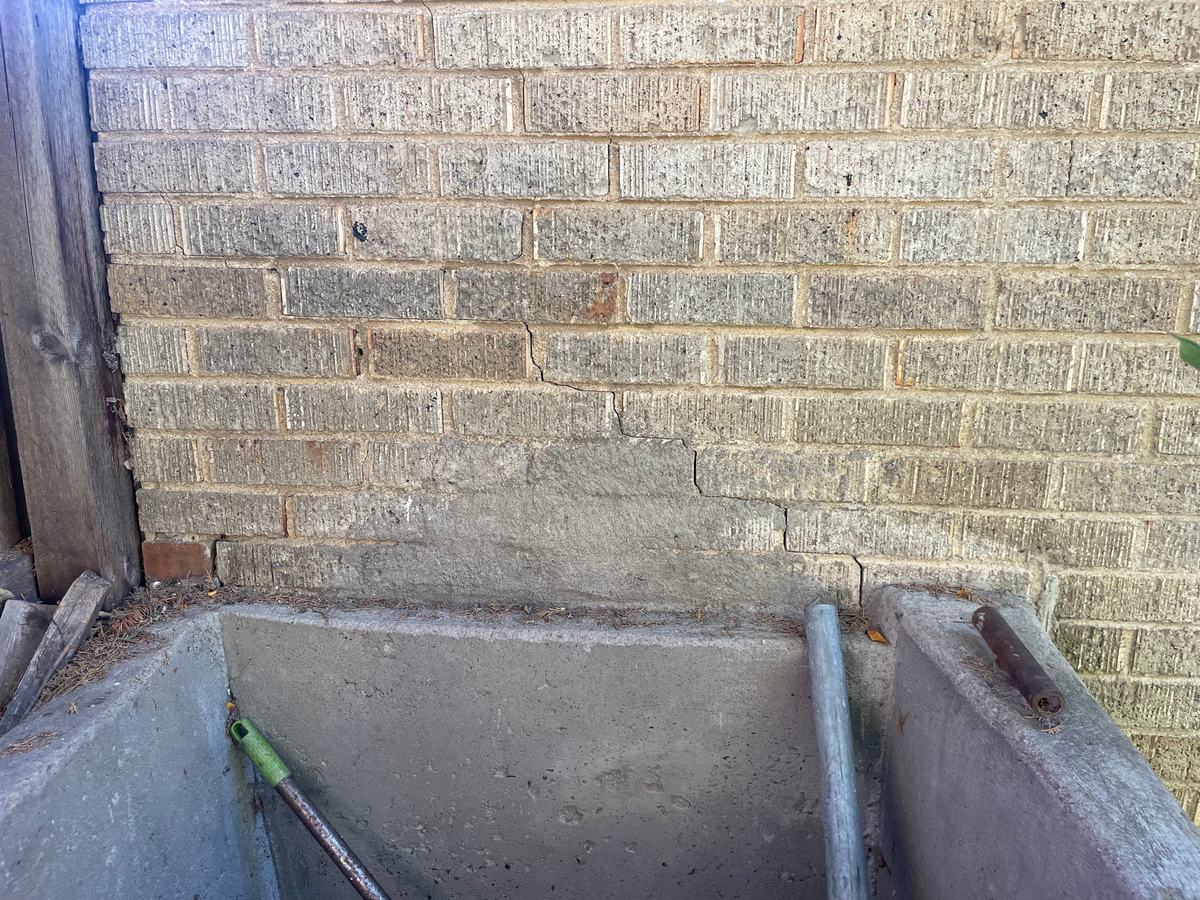
The photo above shows what happens when a crack is patched without fixing what caused it. Someone filled the crack with a gray patch. The wall kept moving, and the crack opened again, right back through the patch.
Patches fail for three reasons:
- The movement has not stopped. If the soil, the water or the lintel that caused the crack is still at work, it will crack the patch too.
- The patch is harder than the wall. A stiff cement patch cannot flex with the brick around it, so it cracks along its edges.
- The patch traps water. Caulk and smeared cement hold water against the brick and make the area worse, and they are hard to remove cleanly later.
How Do You Fix Stair-Step Cracks in Brick?
1. Find and Fix the Cause
We start with water and soil: downspouts, grading, sprinklers and drainage. Where movement looks active or structural, a structural engineer should evaluate the wall before any masonry is repaired. We can work from their findings.
2. Rake Out and Repoint the Cracked Joints
Cracked mortar is removed by hand to a sound depth and the joints are repointed in a mortar that is softer than the brick and matched to the wall in color, texture and joint profile. Done this way, the repair is hard to see.
3. Replace Cracked Bricks in Kind
Bricks that have cracked through are cut out carefully and replaced with salvaged or matched brick of the same size, color and texture.
4. Reinforce Where Needed
Where a wall needs more than new mortar, stainless steel crack-stitching bars can be set into the bed joints across the crack. Larger problems, such as a bulging wall or a failing foundation, are a structural wall and foundation repair, not a crack repair.
What Can You Do Now?
- Mark and date both ends of the crack and photograph it.
- Make sure downspouts carry water well away from the house.
- Check that soil slopes away from the wall.
- Aim sprinklers away from brick.
- Note any doors or windows that have started to stick.
- Do not fill the crack with caulk or smear cement over it.
From Our Work in Denver
The same principles, applied on real Denver buildings.
Highlands Brick and Stone Restoration
An 1892 home in the Highlands (Highland and West Highland area of northwest Denver). We reset a slipped rhyolite arch, repaired carved stones and relaid the brick in lime mortar.
Church of the Advent, Villa Park
A 1913 Denver Landmark restored with a State Historical Fund grant: lime repointing, mortar matching and cast stone repair.
Send Us Photos and Talk It Through
Send us photos. We will personally go through them with you and talk through what we are seeing, on a phone call or a Zoom call, whichever works for you. A photo of the whole wall, a close-up of the crack with a coin for scale, and any older photos you have of the same spot help most.
Prefer to write it all out? Use our consultation request form.
Questions Homeowners Ask
Are stair-step cracks in brick normal?
They are common on older Denver homes, and many are old and stable. Whether yours is normal depends on whether it is still moving. Mark the ends, date them and check them over a few months. A crack that grows, offsets or keeps reopening needs a closer look.
Does a stair-step crack mean foundation problems?
Often it means some part of the foundation moved, usually because the soil under it got wetter or drier than the rest. That does not always mean the foundation is failing. Fixing the water around the house is often the first and most important step. If the crack is widening or the wall is out of line, have it evaluated.
Can I just fill a stair-step crack with caulk or mortar?
We advise against it. Caulk and smeared cement trap water and fail when the wall moves again, and they are hard to remove cleanly later. The lasting repair is to fix the cause, rake out the cracked joints and repoint them with a mortar softer than the brick.
How do you fix stair-step cracks in brick?
Fix the cause first, usually water and soil. Then rake out the cracked mortar, repoint it with a matched, compatible mortar, replace any bricks that have cracked through and, where needed, reinforce the wall with stainless steel crack stitching.
When should I call a structural engineer?
If the crack is widening, the bricks have shifted out of line, the wall is leaning or bulging, or doors and windows are sticking, have a structural engineer evaluate it before masonry repairs begin.
Will a stair-step crack get worse?
It can, if the cause is still at work. Cracks also let water into the wall, and in a Denver winter that water freezes. Watching the crack and fixing drainage around the house go a long way toward keeping it from growing.